
Learning to read musical notes
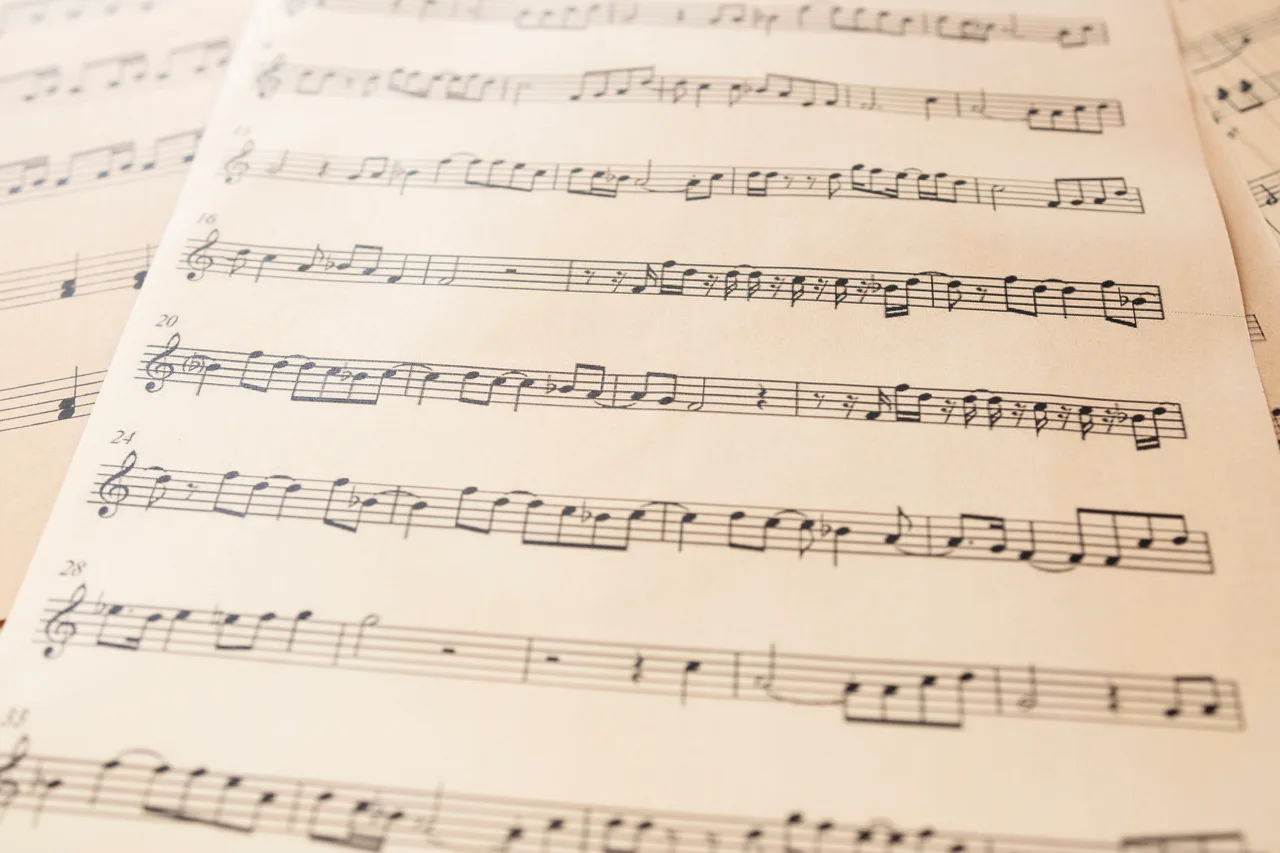
A short guide to reading musical notes in treble clef and bass clef.
Have you always wanted to sight-read as easily as you read text? You're not alone. Every month, thousands of people ask Google how to read musical notes. This short guide introduces the basics of note reading.
1. What is a musical note?
Before being a symbol on a staff, a note is a physical phenomenon. It's a vibration of the air that our brain interprets. The frequency of the note determines the pitch we hear. The faster the vibration, the higher the note. It is measured in Hertz (Hz). A guitar playing A 440 oscillates and creates a vibrating motion that repeats 440 times per second. In Western music, all notes are tuned from this 440 Hz reference.
Frequency is the element that seems most obvious when we talk about a note. We must not forget the other parameters that influence a note: its duration (short, long); its intensity (loud, soft); its timbre (the instrument's identity).
Did you know? The terms "high" and "low" are metaphors. Low sounds make your chest vibrate, while high sounds often resonate in your head!
2. The history of note names
The A-B-C-D-E-F-G note system is actually the oldest. It comes from the Greeks and Romans who simply used their alphabet to name frequencies. In those days, the scale started on A (hence the letter A). This "alphabetic" system survived and became standard in Germanic and Anglo-Saxon cultures (United States, United Kingdom, Germany, Scandinavia).
Conversely, the Do-Re-Mi-Fa-Sol-La-Si system (called the syllabic system) was born from a pedagogical revolution in the 11th century. Guido of Arezzo, an Italian monk of the 11th century, used a religious hymn (Ut queant laxis) to help his choristers memorize the notes. Listen to the hymn Ut queant laxis on YouTube. The first syllable of each line gave: Ut, Re, Mi, Fa, Sol, La. Si was added later (16th century), and Do replaced Ut in the 17th century as it was easier to pronounce and sing.
A common pitfall: In Germany, they use the letters too, but with a twist—they use H for natural B and B for B flat, due to an old transcription error!
Correspondence between syllabic and letter note names
| Note (syllabic) | Note (letter) |
|---|---|
| Do | C |
| Ré | D |
| Mi | E |
| Fa | F |
| Sol | G |
| La | A |
| Si | B |
3. How to read notes on a staff
The staff is made of 5 lines and 4 spaces. It's the reading grid for note pitch. The position of the note corresponds to the position of the note head (the oval) on the staff. Each line and space corresponds to a note and thus to a pitch.
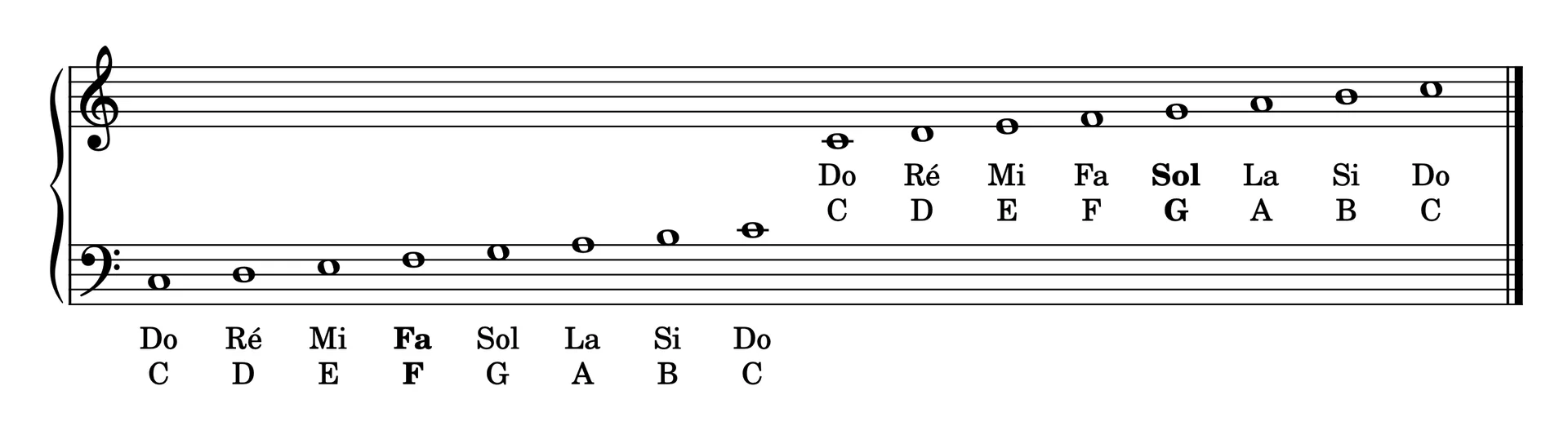
A staff without a clef means nothing. The treble clef (G clef) fixes the note "G" on the 2nd line. The bass clef (F clef) fixes the note "F" on the 4th line. Other clefs exist. The treble clef is used for higher notes and the bass clef for lower notes.
The illustration below shows a scale from C to C in bass clef (bottom staff), then from C to C in treble clef (top staff), with note names in syllabic and letter form.
Want to get started and practice at your own pace? Try our app.
Share